
Knauf vs Fabufill
Knauf vs Fabufill Insulation – Which Is Better?
If you’re comparing Knauf vs Fabufill insulation, you’re looking at two commonly used ceiling insulation options in South Africa:
- Knauf – glasswool insulation
- Fabufill – polyester insulation
Both products are used as ceiling insulation in residential and commercial buildings, but they differ in performance, material properties, and long-term value.
You can also explore all our insulation comparisons to compare different materials, brands, and applications.
Here’s how Knauf and Fabufill insulation compare, including performance, pricing, and which option is better for your home.
Quick Answer
- Best overall performance: Knauf
- Best thermal efficiency: Knauf
- Best fire resistance: Knauf
- Best comfort (soft to handle): Fabufill
Both products work, but Knauf offers higher performance, while Fabufill focuses more on comfort and ease of handling.
Knauf vs Fabufill Comparison
| Feature | ||
|---|---|---|
| Material | Glass mineral wool | Polyester |
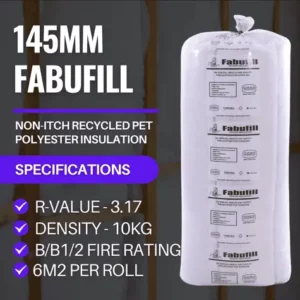
| Thermal Performance | High (R-value ±3.38) | Moderate (R-value ±3.17) |
| Fire Rating | Non-combustible (A1) | Lower resistance (B) |
| Acoustic Performance | Strong sound absorption | Low sound absorption |
| Density | Higher (12kg) | Lower (10kg) |
| Comfort (handling) | Soft-touch (low itch) | Very soft, non-irritating |
| Lifespan | Long-lasting and stable | Long-lasting and stable |
| Typical Price Range | ±R899 per roll | ±R710 per roll |
Thermal Performance
Knauf is known for stronger thermal performance.
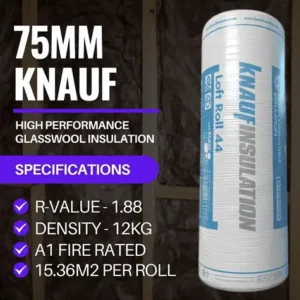
- 135mm Knauf provides an R-value of around 3.38
- This helps reduce heat loss in winter and heat gain in summer
Fabufill still provides insulation, but due to its material and density:
Its thermal performance is generally lower compared to glasswool
Fire Safety
There is a clear difference here:
- Knauf = A1 fire rating (non-combustible)
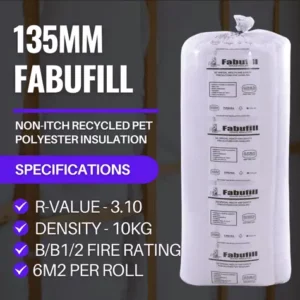
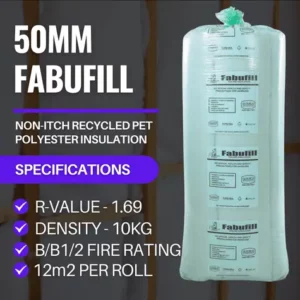
- Fabufill = B-class fire rating (not combustible)
An A1 rating means the material is non-combustible and does not contribute to fire spread, which is a significantly higher standard than B-class insulation.
In most residential applications, both products are used safely, but Knauf offers a much higher level of fire resistance and overall fire safety.
If fire resistance and safety is a key requirement for your project, you can also all explore our fire-rated insulation products designed for high-risk and compliance-focused applications.
Acoustic Performance
Knauf performs well in reducing noise due to its higher density and mineral fibre structure.
At around 12kg/m³ density compared to Fabufill’s ±10kg/m³, Knauf glasswool is more effective at absorbing and dampening sound, particularly for airborne noise.
Fabufill still provides sound absorption and can improve overall comfort, but its lower density means it typically does not reduce noise to the same level.
For homes where noise reduction is important,
Knauf is generally the better choice for acoustic performance
Price and Value
Pricing between the two can appear similar at first, but the coverage per roll is different:
- Knauf: ±R899 per roll (covers ±9m²)
- Fabufill: ±R710 per roll (covers ±6m²)
When broken down per square metre:
- Knauf ≈ R100/m²
- Fabufill ≈ R118/m²
While Fabufill may seem cheaper per roll,
Knauf is still more cost-effective per m²
In addition to lower cost per coverage area, Knauf also provides stronger thermal, acoustic, and fire performance, making it the better overall value.
Real-World Recommendation
Choose Knauf if:
- You want stronger thermal performance
- You want higher fire resistance
- You are insulating a main living space
- You want long-term efficiency
Choose Fabufill if:
- You prefer a softer, non-irritating material
- You are insulating a less critical area (garage, rental, etc.)
- Comfort during installation is a priority
Final Verdict
Both Knauf and Fabufill are widely used insulation products
However:
- Knauf offers higher overall performance for less money
- Fabufill offers comfort and ease of handling at a higher cost
Best overall:
Knauf Insulation
Good alternative:
Fabufill Insulation
Compare Knauf and Fabufill Insulation Options
Now that you’ve seen the differences, here are some of the most popular Knauf and Fabufill insulation options available:




What To Do Next
- View Knauf insulation prices
- View Fabufill insulation prices
- Shop ceiling insulation
- Shop roof insulation
- Browse polyester insulation